
We’ve seen plenty of trailers come into the shop with brake fade complaints during the hottest months of the year. In many cases, the problem isn’t worn brake components—it’s overheated brake fluid. DOT 4 gives your hydraulic system a larger safety margin against vapor lock, helping maintain reliable braking when Tucson temperatures soar above 110°F.
Why Tucson’s Heat Pushes Trailer Brake Systems to Their Limits
When trailer owners think about heat-related towing problems, they usually focus on tires, wheel bearings, or engine temperatures. What often gets overlooked is the hydraulic fluid inside the brake system.
Over the years, technicians who service trailers in Southern Arizona have observed that many braking complaints stem from overheated brake fluid rather than worn mechanical components. A trailer may appear mechanically sound while still experiencing reduced braking performance when fluid temperatures become excessive.
Horse trailers, equipment haulers, and commercial trailers in Southern Arizona need reliable brake fluid. When a loaded trailer slows down, kinetic energy must be converted into heat through friction at the brake assemblies. That heat transfers directly into the drums, wheel cylinders, hydraulic lines, and ultimately the brake fluid.
Once brake fluid reaches its boiling point, hydraulic pressure begins to fail. That is where DOT 4 fluid becomes critically important.
Understanding How DOT 3 Brake Fluid Fails in Desert Conditions
Most hydraulic trailer braking systems rely on glycol-based brake fluid to transfer force from the actuator to the wheel cylinders. The entire system depends on one simple principle:
Liquids cannot be compressed. When the actuator applies pressure, that force travels through the hydraulic fluid and activates the brakes. The problem begins when moisture enters the system.
Brake fluid is hygroscopic, meaning it naturally absorbs moisture from the atmosphere over time. Even in Arizona’s dry climate, water contamination gradually enters through vented reservoirs, flexible hoses, temperature cycling, and seasonal humidity changes. As moisture levels increase, the fluid’s boiling point decreases.
Unlike liquid, vapor can be compressed. Once vapor pockets form inside the hydraulic system, part of the braking force is spent compressing gas rather than applying the brake shoes. The result is reduced braking performance, increased stopping distance, and inconsistent pedal feel.
Why Mountain Descents Around Tucson Create Ideal Vapor Lock Conditions
Southern Arizona creates unique operating conditions for trailer brakes. One of the most demanding routes is the descent from Mount Lemmon. Dropping thousands of feet in elevation requires sustained braking that continuously generates heat at the wheel ends.
Additional stress occurs during:
- Long stretches of slow-moving Interstate 10 traffic that keep brakes working overtime
- Constant braking and acceleration along Interstate 19 during peak travel periods
- Heavy equipment hauling across Tucson construction corridors and industrial areas
- Regular horse trailer trips between Tucson, Sonoita, Benson, and nearby equestrian facilities
- Summer towing conditions where air temperatures exceed 110°F and pavement temperatures climb even higher
Pavement temperatures throughout Tucson regularly exceed 150°F during the summer months. When road temperatures combine with friction heat generated inside the brake drum, wheel-end temperatures can rise dramatically.
If moisture-contaminated DOT 3 fluid reaches its wet boiling point, vapor lock becomes increasingly likely. When brake fluid starts struggling with the heat, the warning signs are usually hard to miss:
- A brake pedal that feels softer or spongier than normal
- Less confidence when slowing down with a loaded trailer
- Brakes that seem to lose effectiveness during long descents
- Stopping performance that feels inconsistent from one stop to the next
Why DOT 4 Provides a Larger Thermal Safety Margin
DOT 3 and DOT 4 fluids are both glycol-based brake fluids, but DOT 4 formulations include borate ester additives that improve high-temperature performance. The primary difference is boiling-point resistance.
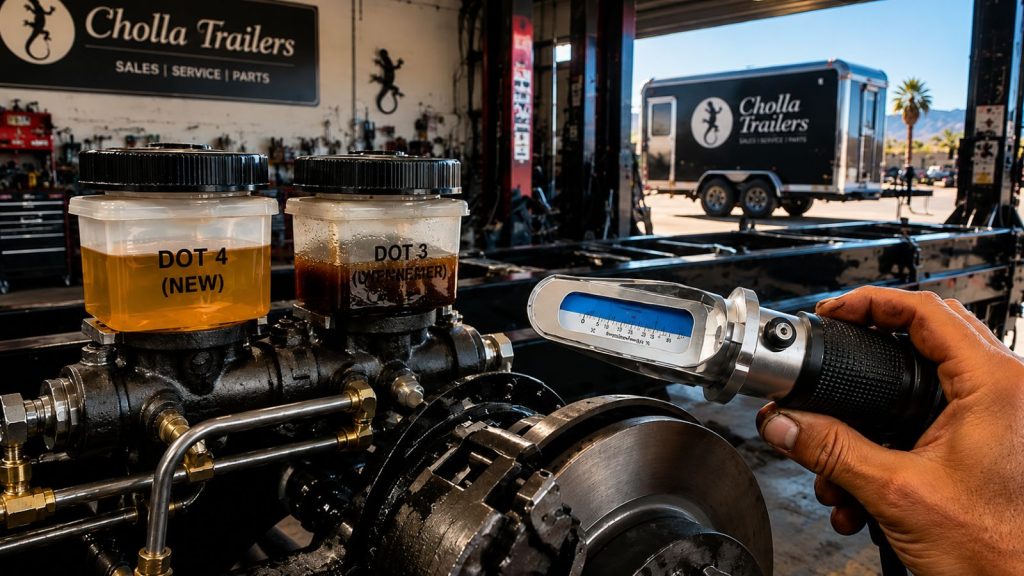
Minimum Federal DOT Standards
| Fluid Type | Dry Boiling Point | Wet Boiling Point |
| DOT 3 | 401°F (205°C) | 284°F (140°C) |
| DOT 4 | 446°F (230°C) | 311°F (155°C) |
The additional thermal margin may appear modest on paper. In real-world towing conditions, however, those extra degrees can determine whether the hydraulic system remains fully functional or begins producing vapor.
The critical difference is that vapor lock does not develop gradually. Once moisture-contaminated fluid reaches its wet boiling point, vapor pockets can form rapidly within the hydraulic circuit.
DOT 4 provides additional protection by maintaining a higher wet boiling point and a larger thermal safety margin during severe towing conditions.
This is why DOT 4 is often recommended for trailers regularly exposed to:
- Mountain descents
- Horse trailer hauling
- Commercial equipment transport
- Heavy summer towing
- Frequent stop-and-go braking
How Trailer Brake Repair Restores Hydraulic Performance
When vapor lock develops, simply topping off the reservoir rarely solves the problem. The issue affects the entire hydraulic system, not just the fluid visible in the reservoir. At Cholla Trailers, trailer brake repair for heat-related braking complaints typically begins with a complete hydraulic system inspection.
We know how frustrating it is when your trailer brakes just don’t feel right, especially when you have a job to do or animals to move. While it’s tempting to just top off the fluid and hope for the best, that usually only masks the underlying issue. To truly keep you safe on the road, we perform a thorough inspection of your entire hydraulic system to ensure every component is handling the Tucson heat exactly as it should.
As part of our commitment to your safety, our technicians carefully evaluate:
- Surge brake actuators
- Master cylinders
- Hydraulic lines
- Wheel cylinders
- Brake shoes
- Brake drums
- Fluid condition
One of the most common findings is moisture-contaminated fluid that has lost much of its original boiling-point protection. Rather than replacing only the reservoir fluid, the entire hydraulic circuit should be flushed to remove moisture-contaminated fluid from the wheel cylinders, lines, and actuator.
Fresh DOT 4 fluid helps restore hydraulic consistency while providing greater resistance to future vapor lock events.
A Common Summer Brake Failure Pattern We See
Many summer brake complaints follow a similar progression. The trailer performs normally when the system is cold. As towing continues, wheel-end temperatures increase. Braking remains acceptable for the first several stops. Then the driver notices a softer pedal feel.
Eventually braking performance becomes inconsistent during longer descents or repeated stops. Using OEM-level diagnostic procedures, we frequently discover that fluid contamination—not mechanical failure—is contributing to the problem.
In many cases, restoring fluid quality and performing a complete hydraulic service resolves the issue without major component replacement.
Why Horse Trailers Demand Consistent Brake Performance
Horse trailers represent a significant portion of the trailers we service throughout Southern Arizona. Unlike equipment trailers carrying stationary cargo, horse trailers transport live animals that naturally shift weight during braking events. Consistent hydraulic brake performance helps reduce abrupt load transfers and contributes to safer towing behavior.
Many horse trailer owners regularly travel between Tucson, Vail, Benson, Sonoita, and Green Valley, creating a combination of long-distance towing, elevation changes, and extreme temperatures. Maintaining high-quality brake fluid is one of the simplest ways to improve braking consistency in these applications.
Warning Signs Your Brake Fluid Is Breaking Down
Watch for these warning signs:
- Soft or spongy brake pedal feel
- Reduced braking performance after repeated stops
- Brake fade during mountain descents
- Dark or contaminated fluid
- Burning brake odor
- Inconsistent stopping response
These symptoms should be addressed before they become safety concerns.
Preventing Brake Fluid Failure in Southern Arizona
Arizona’s combination of heat, elevation changes, and seasonal monsoon moisture creates unique challenges for hydraulic trailer brakes. For most trailers operating throughout Southern Arizona, brake fluid inspections every 12 to 24 months are a practical preventative maintenance strategy.
Horse trailers, commercial equipment trailers, and high-mileage units may benefit from more frequent evaluations. Preventative maintenance is significantly less expensive than repairing a braking system after vapor lock or severe brake fade has already occurred.
Protect Your Trailer Before Summer Brake Problems Develop
Trailer repair specialists in Southern Arizona commonly encounter heat-related brake issues, including fluid breakdown, reduced braking efficiency, and premature wear of braking components. If your trailer brakes feel soft, fade in the heat, or stop inconsistently, don’t ignore it. A hydraulic brake inspection can catch bad fluid, moisture contamination, or pressure problems before they turn into a serious towing risk.
Cholla Trailers performs trailer brake inspections, hydraulic diagnostics, DOT 4 fluid exchanges, axle service, and complete trailer brake repair at 1933 E Eastland St, Tucson, AZ 85719. Qualifying repairs are backed by a 12-month workmanship warranty.
Frequently Asked Questions
Can I mix DOT 4 brake fluid with DOT 3 fluid?
Yes. DOT 3 and DOT 4 fluids are chemically compatible. However, mixing them reduces the overall boiling-point performance of the final fluid mixture and limits the full benefits of DOT 4.
Does Arizona’s dry climate prevent brake fluid contamination?
No. Brake fluid naturally absorbs moisture through venting cycles, hose permeability, and seasonal humidity changes. Even in Southern Arizona, contamination gradually accumulates over time.
How can I tell if vapor lock is occurring?
Yes, there are warning signs. Vapor lock often causes braking performance to worsen as temperatures increase. Drivers frequently report a firm pedal when cold and a softer pedal after repeated braking events.
Is DOT 4 worth upgrading to for trailer towing?
Yes. DOT 4 provides higher wet and dry boiling points than DOT 3, making it a valuable upgrade for trailers operating in extreme heat and demanding towing conditions.